I²CNER研究シーズ

  • 材料・輸送・熱

Gas separation, Vapor deposition, Small molecules

Baloh, Pavlo

学術研究員

  • 研究ユニット:マルチスケール構造科学ユニット
  • E-mail:

研究概要

Surface layer modification of PDMS membranes using vapor deposition methods

In this research, I focus on the physical vapor deposition of small molecules onto the polydimethylsiloxane (PDMS) surface to enhance the selectivity of CO₂/N₂ gas separation. The idea is that specific small molecules with chosen functional groups will provide a suitable CO₂ affinity to improve the CO₂ gas transport through the membrane. Using physical vapor deposition is a novel approach in this direction. The deposition from the vapor phase enables the uniform coating of the membrane surface with precise nanoscale thickness control. It also prevents negative effects that occur when exposing the polymer to organic solvents during wet chemistry approaches.
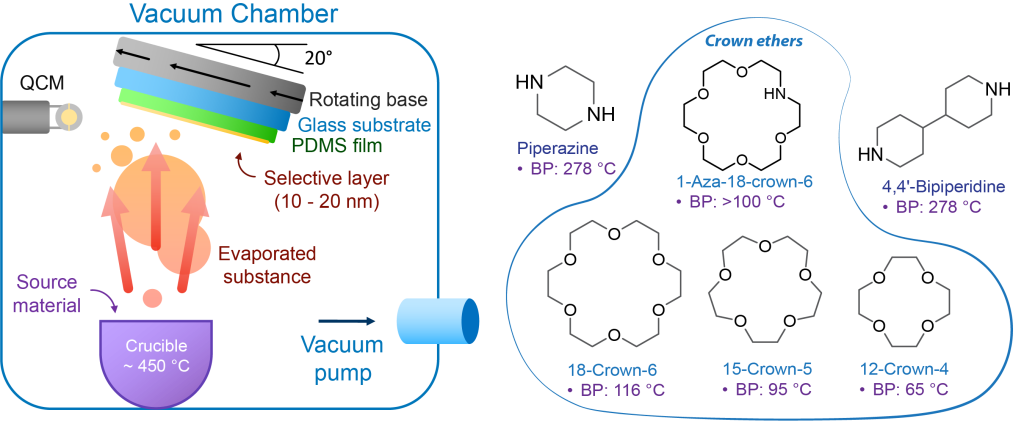
Schematic illustration of the Physical Vapor Deposition (PVD) for selective layer application; Candidate materials for the selective layer – Piperazine, Bipiperidine and Crown ethers with various boiling points.

技術

  • Physical Vapor Deposition of the non-toxic compounds. Thermal evaporation of the compounds using resistance heating under high vacuum. The material vapor deposits onto a “cool” substrate, creating a thin coating.
  • Spectroscopic Ellipsometry. Allows for estimation of the optical properties of thin films as well as their thickness. Non-destructive method utilizing polarized light as a probe. The comparison of light polarization before and after interacting (reflecting) with the sample surface describes the optical properties, such as refraction and extinction indices, and estimates the film thickness. Works best for a thickness range of 0.01 – 1 μm.