- 材料・輸送・熱
- CO₂分離
- 水素エネルギー
- 二酸化炭素(CO₂)
Adsorption based CO₂ and H₂ storage, Thermofluids, Porous adsorbents
Chakraborty, Anutosh (PI)
准教授・主任研究者
- 研究ユニット:マルチスケール構造科学ユニット
- E-mail:
- Website:https://dr.ntu.edu.sg/cris/rp/rp00753

准教授・主任研究者
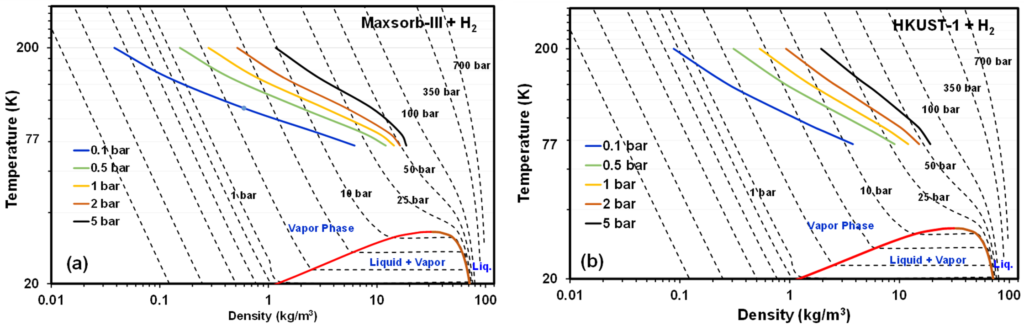
For CO2-free power generation in power plants or vehicles, hydrogen should be implemented as H2 possesses not only the highest energy density (120MJ/kg) but also can be generated from the environment and reactions. However, H2 is difficult to store due to its low density at ambient conditions. To understand the efficacy of hydrogen interactions in porous materials including the randomness of hydrogen adsorption in terms of storage density, energy flow and dissipation, a thermodynamic study is required. This project focuses on the study of H2 adsorption on various porous adsorbents such as activated carbons (AC types Maxsorb-III) and metal-organic frameworks (types UiO-66 (Zr) and HKUST-1 MOFs) and the results are presented in temperature-density co-ordinate system. Employing experimentally confirmed isotherms data of AC/MOFs + H2 systems, the density of H2 adsorbed phase, is evaluated. These results indicate the feasibility of hydrogen adsorption on functional adsorbents at various temperature and pressure. The results show that the adsorbed phase densities of H2 on Maxsorb-III and HKUST-1 increase up to 18 kg/m3 and 20 kg/m3 at 5 bar and 77K.
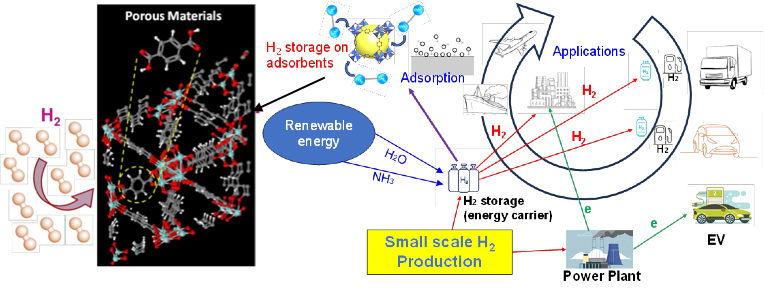
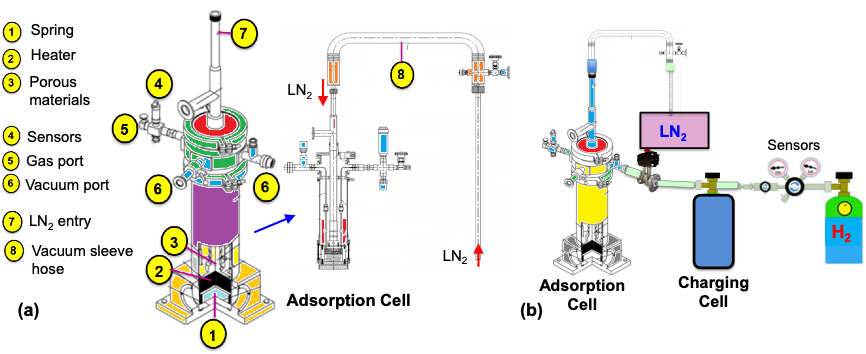
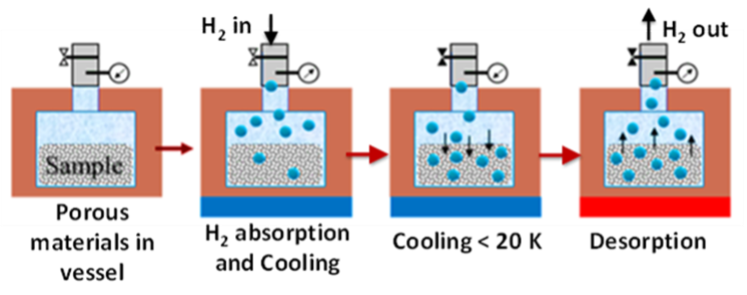
The project comprises the development of adsorption-based-H2 storage. Hence the project begins with the possible solution of H2 boil-off and the evaluation of H2 pressurization periods. Due to high boil-off losses, the phase change from liquid to gaseous hydrogen causes a considerable volume change, which makes challenging for long-term storage/transportation of hydrogen. Therefore, a central challenge is to develop a highly efficient H2 storage system with nearly zero boil-off loses employing adsorption technology under cryogenic conditions (20 K to 77K). Hence the H2 storage capability increases due to strong hydrogen-porous-adsorbents interactions as compared to H2-H2 interaction, which makes boils-off at higher temperature > 20 K.
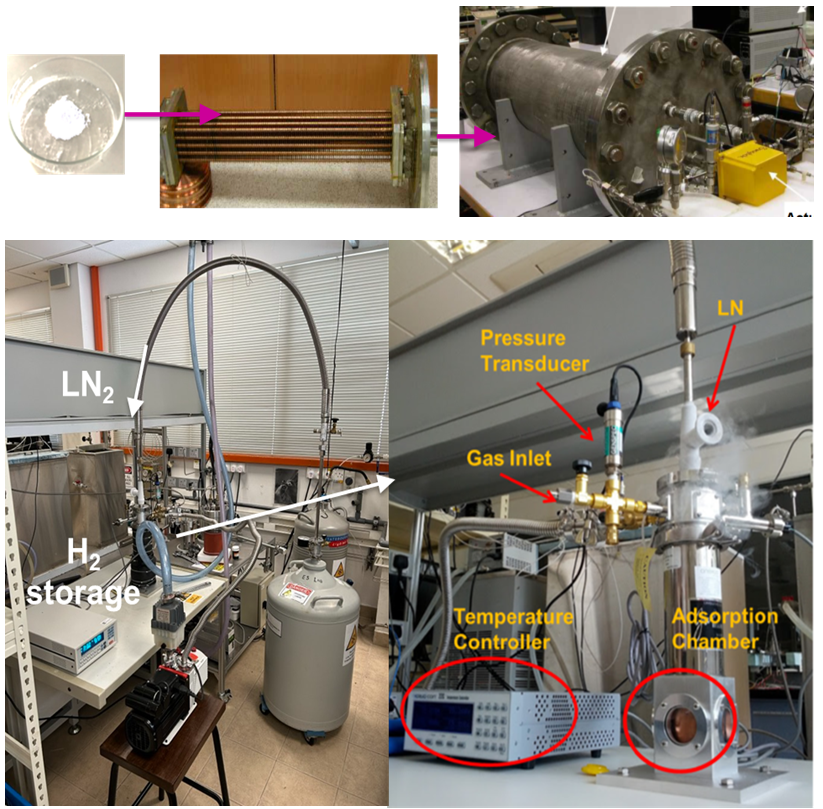
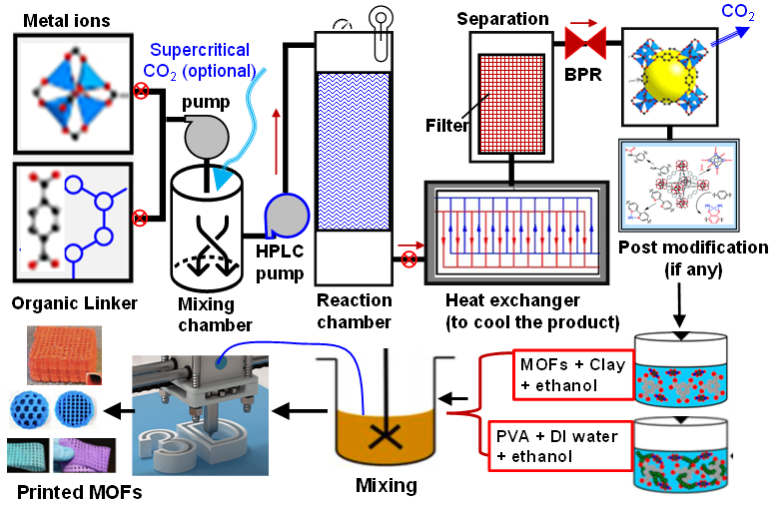
The existing MOFs fabrication procedure consumes time, which hinders the use of MOFs in large scale application or system level. Therefore, it is required to produce MOFs continuously. For continuous and large-scale production, the MOFs synthesisation system comprises of mixing chamber, auto-clave reactor, cooler, filter, high pressure rated pipes and valves (SS316), HPLC (high performance liquid chromatography) pumps and one back pressure regulator (BPR).
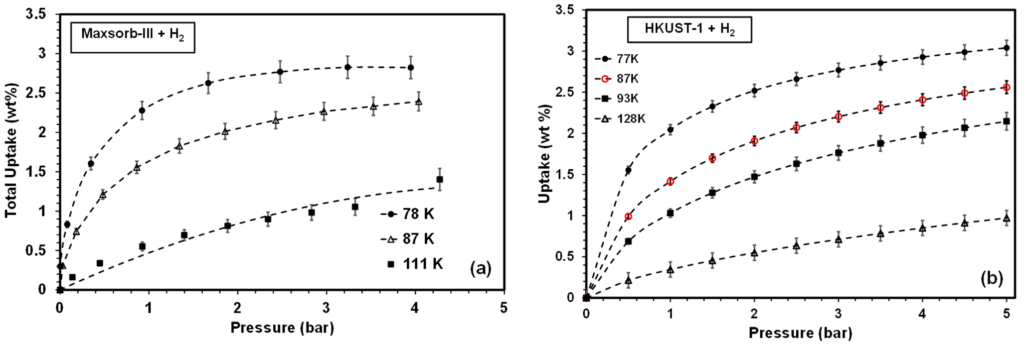
We measured the amount of hydrogen in porous materials under cryogenic conditions (77.4 K, 87 K and 112 K). These isotherms conditions are maintained at 77.4 K (controlled by liquid N2) 87 K (by liquid Ar) and 111 (by liquified natural gas, LNG) for practical hydrogen storage by cryo-adsorption technology. The limiting uptake is found 2.8% at 78 K for maxsorb III. Secondly, the hydrogen uptakes on HKUST-1 MOFs are shown at the temperatures of 77 K, 87 K, 93 and 128 K, and pressures up to 5 bar. The isotherms are type I with the limiting uptake of 3%.
Adsorption phenomena on the micropore of an adsorbent surface (Hence q is the amount of hydrogen uptake, ρads is the density of adsorbed phase, vp and vsk are pore volume and skeletal volume, respectively).
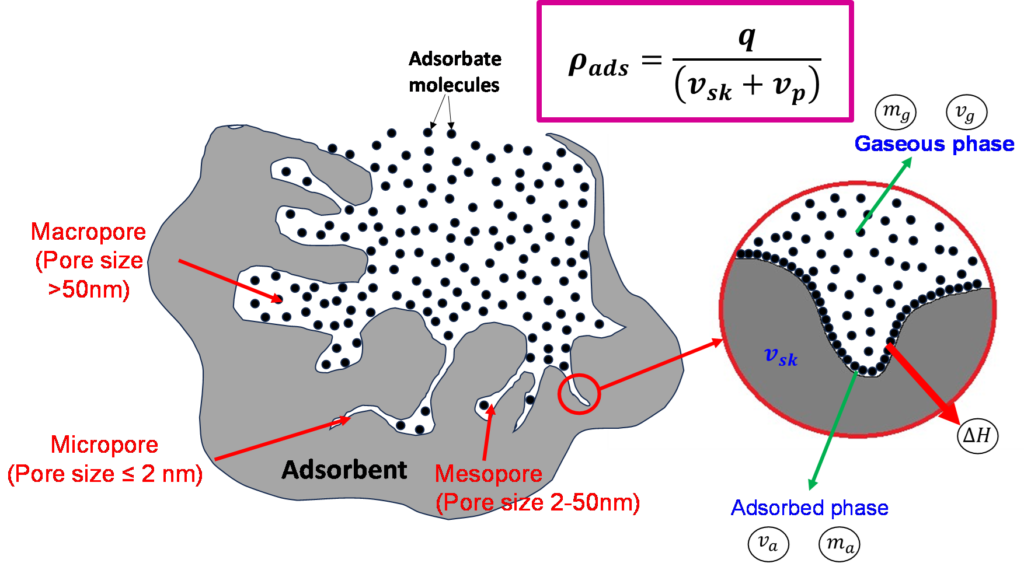
The adsorbed density depends on the loadings of hydrogen on porous materials along with the pore and skeletal volumes of adsorbents. The plots of ρads against temperature for various pressure are presented here.