I²CNER研究シーズ

  • 材料・輸送・熱
  • 水素エネルギー
  • 電池

Hydrogen, Electrolysis

Skinner, Stephen John (PI)

教授主任研究者

研究概要

Solid oxide cell electrolysis

As we strive towards adopting net zero carbon technologies, new sources of alternative fuels must be developed. One of these potential fuels is hydrogen.  The key challenge with hydrogen is how is this produced at scale, and one solution to this is through the use of solid oxide electrolysers. These are electrochemical devices based on either an oxide ion or proton conducting electrolytic membrane, paired with ceramic electrodes with high electronic and ionic conductivities. The purpose of this research task is the development of new electrode materials for both types of cell that demonstrate both improved hydrogen production and increased durability.

Ammonia decomposition catalysis

One alternative approach to the generation of a hydrogen fuel is the use of an established hydrogen vector that has an existing transport infrastructure. This is the conversion of ammonia (NH3) using novel new catalysts tuned to its decomposition. We have developed, and continue to develop, a range of new materials approaches to the conversion of ammonia to a hydrogen gas stream in which unconventional materials are explored. Our work involves the investigation of nitrides and oxide nitrides, as well as oxides that are known to exsolve active metallic nanoparticles that will increase H2 production rates at lower temperatures.

Isotopic exchange and diffusion

To support the development of the electrode materials outlined above we use 18O2 and D2O isotopic labels to directly probe ion transport and provide kinetic data, notably diffusion and surface exchange coefficients, on electrodes and electrolytes for solid oxide cells. These measurements are able to distinguish mobile species in a range of environments, and now include the ability to measure the ion transport under an applied electrical load.

Isotopic Labelling Facility

技術

Low energy ion scattering (LEIS) and atom probe tomography (APT)

These advanced capabilities allow the characterization of the outermost surface composition of materials with atomic layer resolution, enabling investigation of cation segregation phenomena. This is complemented with APT measurements that allow the grain boundary composition to be probed directly, identifying cation and anion vacancy contents, allowing further understanding of device durability.

Isotopic Exchange

Suite of apparatus to allow isotopic labelling with both dry and wet gas atmospheres, allowing analysis of both oxide ion and proton transport mechanisms.

Hi5 pFIB-SIMS

Our facilities include a new and unique dual detection secondary ion mass spectrometry system to image and analyse complex interfaces in devices with high spatial resolution, and under operando conditions, with the ability to apply electrical load allowing the electrochemical properties of grain boundaries to be explored.
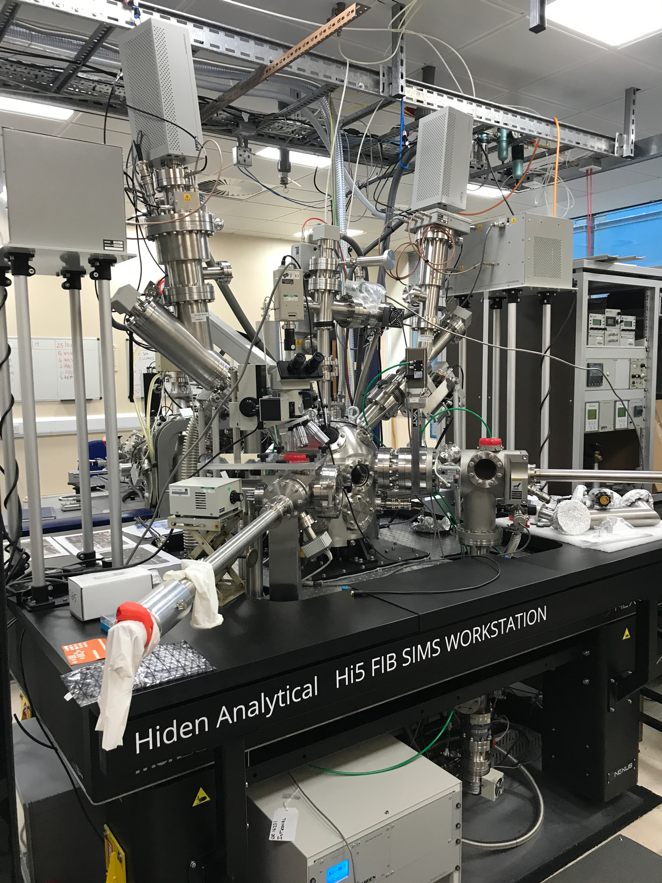
Hi5 pFIB SIMS