I²CNER Research Seeds

  • Material Conversion
  • Carbon Dioxide (CO₂)
  • Nitrogen (N₂)

Microwave chemical process,
Carbon resource recycling

Tsubaki, Shuntaro (PI)

Professor & Principal Investigator

Research Outline

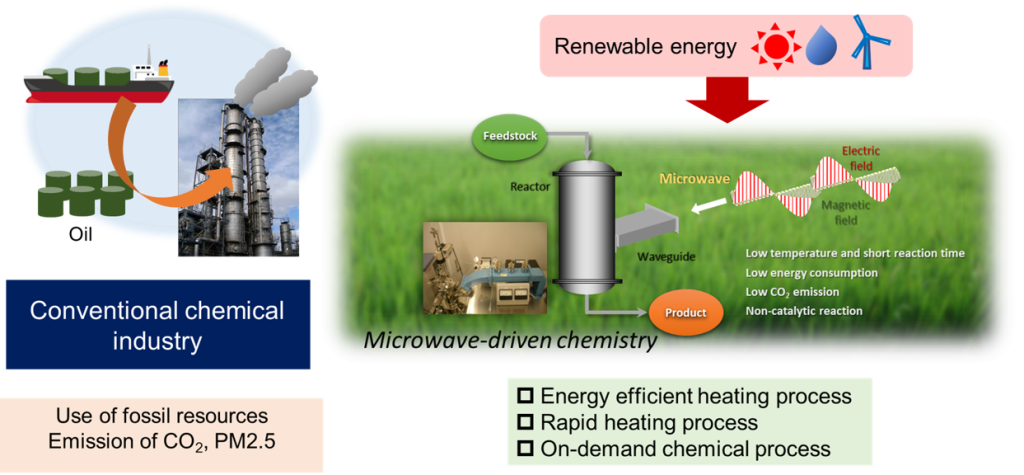
Microwave-Driven Chemistry

We clarify microwave-driven reaction acceleration and apply it to energy-efficient conversion of underutilized carbon resources into valuable products.

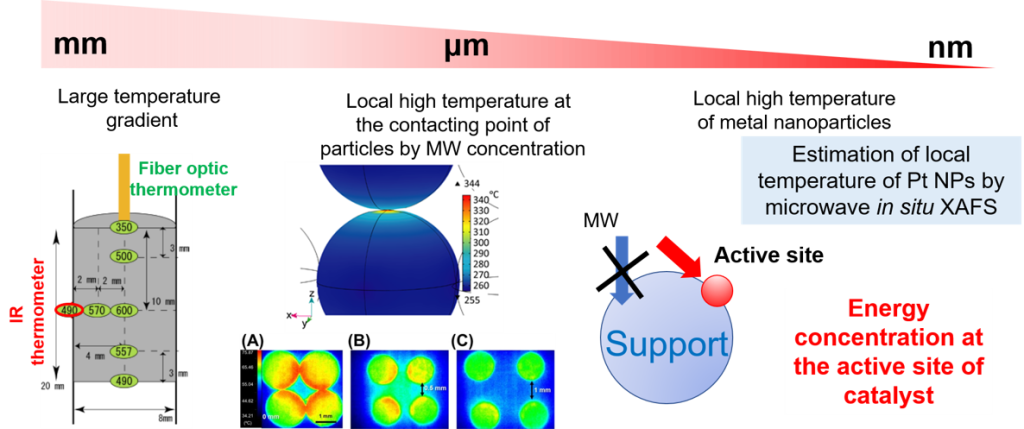
Fundamentals of Microwave-Driven Chemistry

In situ Raman, XAFS, XRD, and SAXS methods reveal localized microwave heating and selective energy delivery to catalytic active sites.

Applications of Microwave Processes

We apply electromagnetic wave heating to resource conversion, CO₂ capture, and bioprocesses using proprietary wide-frequency and magnetic-field reactors.

Research Methods and Facilities

Microwave Heating Facilities and Microwave Absorption Characterization Systems

Microwave and RF facilities ranging between 27 MHz–30 GHz with precise irradiation control, varied reaction cells, thermography, and vector-network-analyzer measurements of microwave absorption.

Microwave In Situ Characterization Facilities

In situ spectroscopy, diffraction, and scattering with thermography enable simultaneous tracking of temperature and structure during irradiation.

Industry-Academia Collaboration for Microwave Processes

As JSPS R074 secretariat, we connect industry and academia to advance electromagnetic-process research, implementation, standardization, and decarbonization.