I²CNER Research Seeds

  • Hydrogen Energy

Tribology, Hydrogen,
Polymer composite, Wear, Biotribology

Sawae, Yoshinori (PI)

Professor & Principal Investigator

Research Outline

Tribo-failure mechanism of polymer composites sliding in hydrogen gas environment

Develop the tribo-failure model of polymer composites sliding in hydrogen gas environment through identifying characteristic tribo-chemical reactions at the sliding interface in hydrogen by dedicated surface analyses, and utilize obtained knowledge to improve durability and wear resistance of polymer tribo-elements.

Reduction of lifecycle environmental footprint of sealing materials for hydrogen energy network

Estimate the lifecycle environmental footprint of rubbers and thermoplastics for sealing elements used in hydrogen energy networks, and subsequently explore ideal fluorine-free alternatives with improved environmental footprint and evaluate their friction and wear properties in hydrogen to examine the suitability for hydrogen seals.

Development of bio-mimetic super-low friction technique with hydrated hydrogel and biological lubricants

Explore the superior lubrication mechanism of natural synovial joint and apply obtained knowledge to develop a novel water lubrication system by mimicking natural joint system, in which hydrated articular cartilage is lubricated by synovial fluid, with hydrated hydrogel and synthetic synovial fluid containing mucopolysaccharides and phospholipids.

Research Methods and Facilities

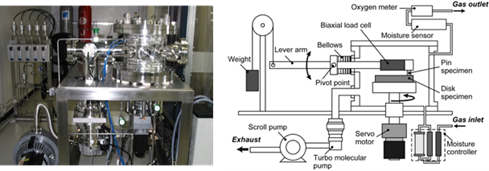
Friction and wear test in high purity hydrogen gas environment

Friction and wear characteristics of various tribo-materials including metals, coatings, polymer composites and rubbers can be evaluated in high purity hydrogen gas environments with precision controlled trace moisture contest.

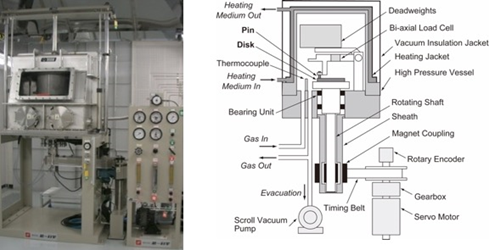
Friction and wear test in high pressure and high temperature hydrogen gas environment

Friction and wear characteristics of various tribo-materials including metals, coatings, polymer composites and rubbers can be evaluated in high pressure (Max. 40 MPa) and high temperature (Max. 100℃) hydrogen gas environment.

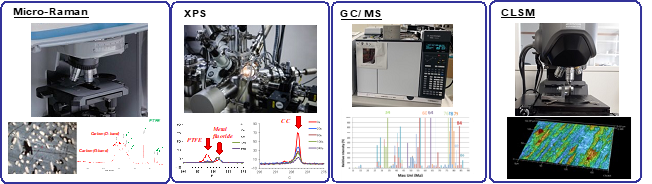
Worn surface and environmental gas analyses for determining tribo-chemical reactions at sliding interface

Tribo-chemical reactions between sliding material surfaces and constituents of sliding environment can be explored by in situ GC/MS gas analysis during sliding tests and various worn surface analyses including XPS, Auge spectroscopy, FT-IR, micro-Raman, CLSM and WLI after the sliding tests.