

The paper of Assoc.Prof. Takeshi Tsuji (CO2 Storage Division, I2CNER) and his collaborators was published in “Geochemistry, Geophysics, Geosystems” on Feb.14, 2014.
■ Summary
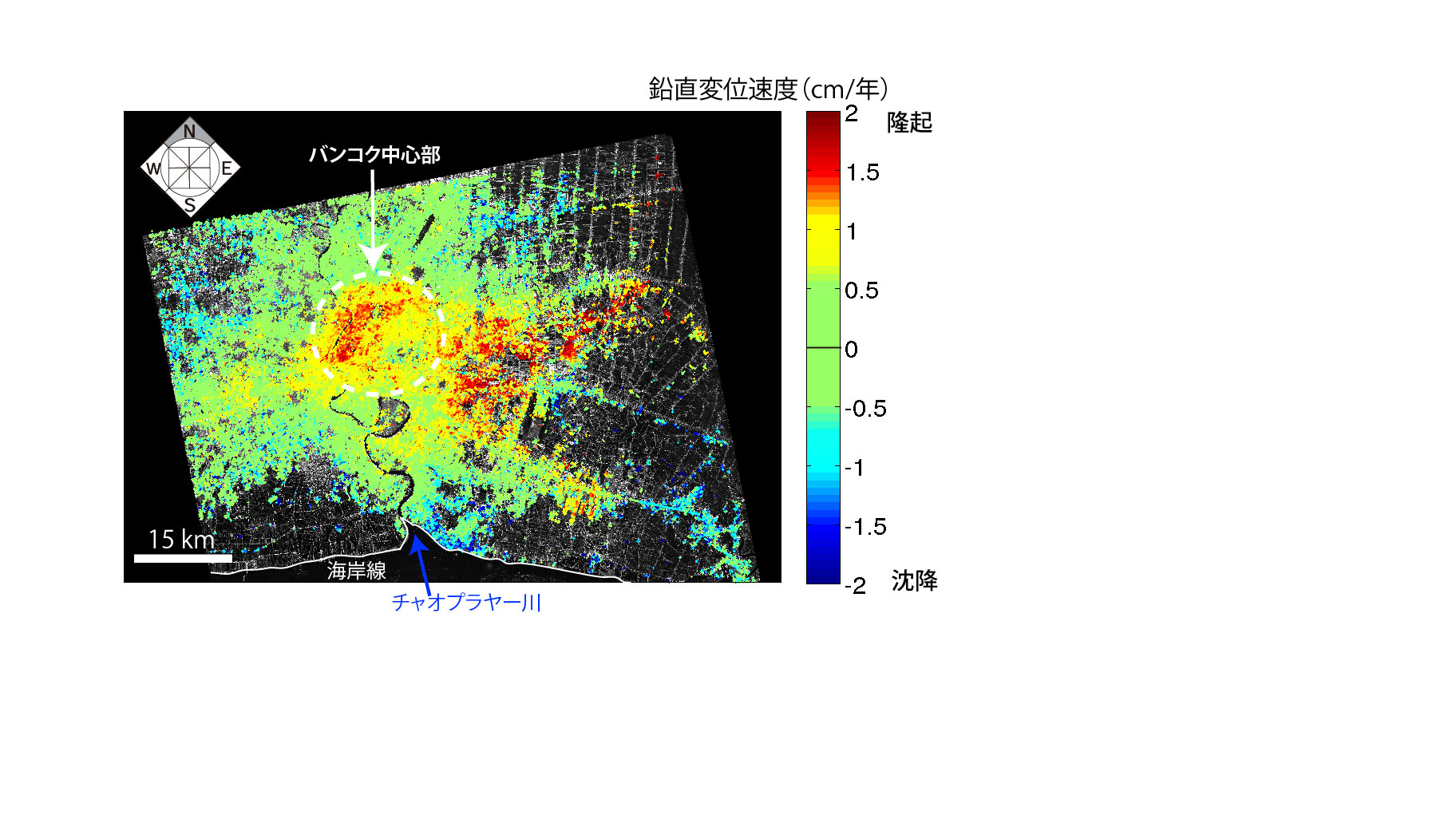
We estimated recent surface displacements around Bangkok by means of persistent scatterer interferometry with ALOS/PALSAR images acquired from November 2007 to December 2010. Land subsidence due to excessive groundwater pumping has been reported in this region. However, we detected ground surface uplift around the mega-city, along with seasonal surface displacement, with high spatial resolution. We then discriminated long-term natural rebound and seasonal displacement by fitting exponential and sinusoidal functions to displacement time-series, and mapped their spatial distributions. This mapping allowed us to infer that the second and third shallowest aquifers are laterally continuous, whereas the shallowest aquifer has lateral discontinuities. The temporal decay rate of the long-term rebound might reflect spatial changes of the Chao Phraya River watershed or the magnitude of the preceding groundwater extraction. We demonstrated that our method of decomposing the displacement time series into different spatial and temporal patterns is useful for understanding aquifer connectivity and the elastic response pattern in an aquifer system.
■Paper
Title:
Authors: Kazuya Ishitsuka, Yo Fukushima, Takeshi Tsuji, Yasuhiro Yamada,
Toshifumi Matsuoka, Pham Huy Giao
DOI:10.1002/2013GC005154
Article published online: 2/14/2014