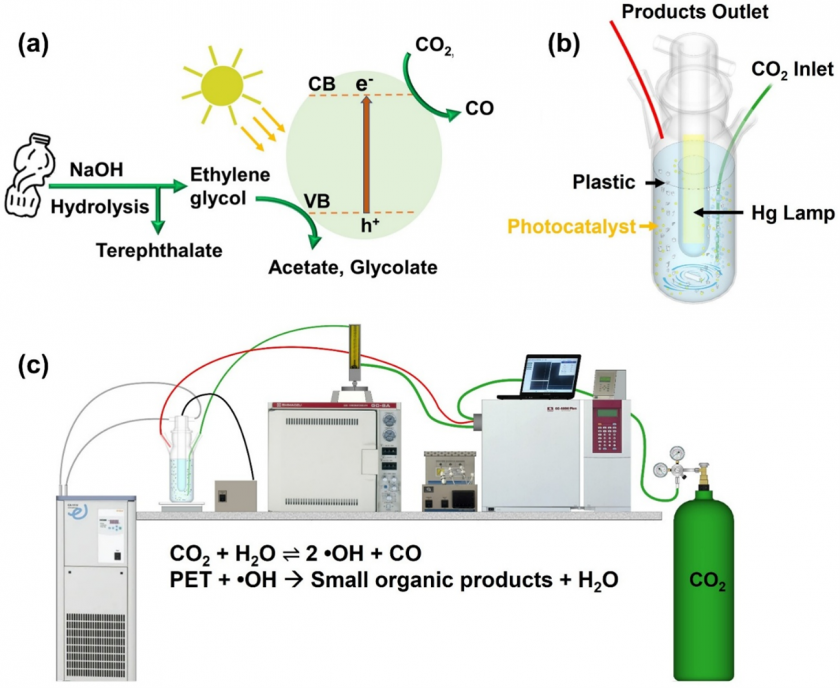

Global CO2 emissions and plastic pollutants are two of the most urgent environmental challenges. Here, I²CNER’s research team has reported a unified photocatalytic strategy that simultaneously converts CO2 and polyethylene terephthalate (PET) waste into value-added products under light irradiation. CO2 is selectively reduced to CO with over 95% selectivity, while PET is transformed to methane, terephthalate, ethylene glycol, glycolate, and acetate. This dual process is enabled by a distorted high-entropy oxide (BaTiNbTaZnO9), containing electron-accepting d0 cations (Ba, Ti, Nb, and Ta), electron-donating d10 cations (Zn), and Lewis-basic Ba sites for CO2 adsorption, whose distorted atomic environment was confirmed by synchrotron X-ray adsorption spectroscopy. The cooperative use of CO2 and plastic as complementary redox partners eliminates sacrificial agents and enhances redox efficiency compared with conventional CO2 conversion. Beyond mitigating two persistent pollutants, this solar-driven approach also suggests a pathway for microplastic degradation, establishing a scalable concept for integrated waste-to-fuel technologies.
“Pollutants to Products: A Tailored Multicomponent Photocatalyst for Simultaneous CO2 and Plastic Waste Conversion”, Small, 2026, DOI:10.1002/smll.202513379