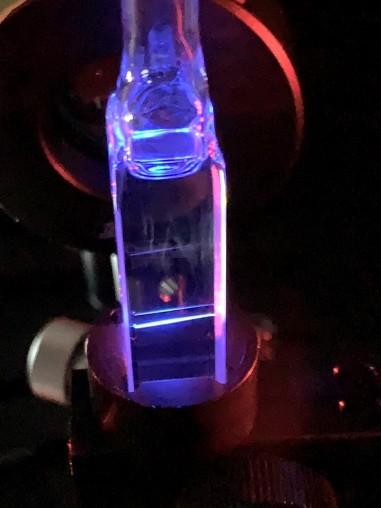

Professor Chihaya Adachi and his research group have developed a new organic molecule that glows when exposed to invisible near-infrared laser light. Furthermore, they have succeeded in making it emit light efficiently as Organic light-emitting diodes (OLEDs).
The following is a abstract of the paper.
[Abstract]
The simultaneous realization of two-photon absorption (2PA) and thermally activated delayed fluorescence (TADF) in a single molecular system remains challenging due to an inherent trade-off in their molecular design requirements. In this study, we present a strategy to enhance both properties by introducing electron-withdrawing substituents into the CzTRZ scaffold, thereby leveraging an electron-withdrawing-enhanced intramolecular charge transfer (EWICT) character. The incorporation of TRZCF3 and TRZCN units effectively enhances the charge transfer (CT) character of CzTRZ, resulting in high 2PA cross-sections (156 GM for CzTRZCF3 and 200 GM for CzTRZCN) and a reduced singlet-triplet energy gap (ΔEST = ES1 – ET1). Computational and experimental studies reveal that incorporating TRZCF3 and TRZCN units selectively stabilizes the S1 state and reduces ΔEST, significantly facilitating the reversed intersystem crossing (RISC) process. Notably, 1c exhibits the fastest RISC rate (kRISC), leading to superior TADF properties and an external quantum efficiency (EQE) of 13.5% in OLEDs. Moreover, a relatively high two-photon brightness of 174 GM is estimated for 1c. These findings demonstrate a rational molecular design strategy for the synergistic enhancement of 2PA cross-sections and excellent OLED performance, paving the way for applications in advanced imaging probes and organic semiconductors.
[Paper Information]
Youhei Chitose, Gomathi Vinayakam Mageswari, Ryota Zenke, Toshiharu Ide, Shintaro Kohata, Ja-Hon Lin, Tzu-Chau Lin, Youichi Tsuchiya, Chihaya Adachi, “Unlocking Dual Functionality in Triazine-Based Emitters: Synergistic Enhancement of Two-Photon Absorption and TADF-OLED Performance with Electron-Withdrawing Substituents”, Advanced Materials, 2025, DOI:10.1002/adma.202509857