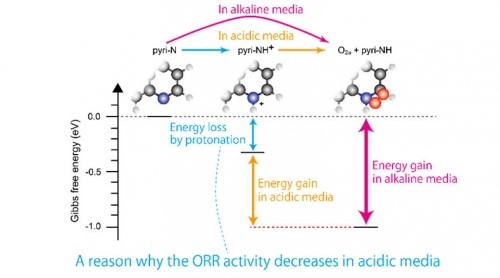

Nitrogen-doped carbon has emerged as a promising low-cost and durable alternative to platinum catalysts for the oxygen reduction reaction (ORR) in fuel cells. However, its catalytic activity decreases significantly in acidic electrolytes, limiting the practical applications. Here, we report the degradation mechanisms of nitrogen-doped carbon catalysts, focusing on the acid-base equilibrium of pyridinic nitrogen (pyri-N), which serves the primary active site. We found that the electrochemical hydrogenation of pyri-N to pyri-NH, coupled with oxygen adsorption, is a critical process. Although this reaction occurs at higher potentials in basic electrolytes, it shifts to lower potentials in acidic environments due to the protonation and stabilization of pyri-N. These results demonstrate that the decrease of the catalytic activity in acidic electrolytes is tied to the basicity of pyri-N. By controlling the basicity of pyri-N, specifically its pKa, a guideline for enhancing the ORR and other electrode reactions has been established.
Kenji Hayashida; Junji Nakamura; Kotaro Takeyasu, “Why Does the Performance of Nitrogen-Doped Carbon Electrocatalysts Decrease in Acidic Conditions?”, Angewandte Chemie International Edition: May 2, 2025, DOI:10.1002/anie.202502702