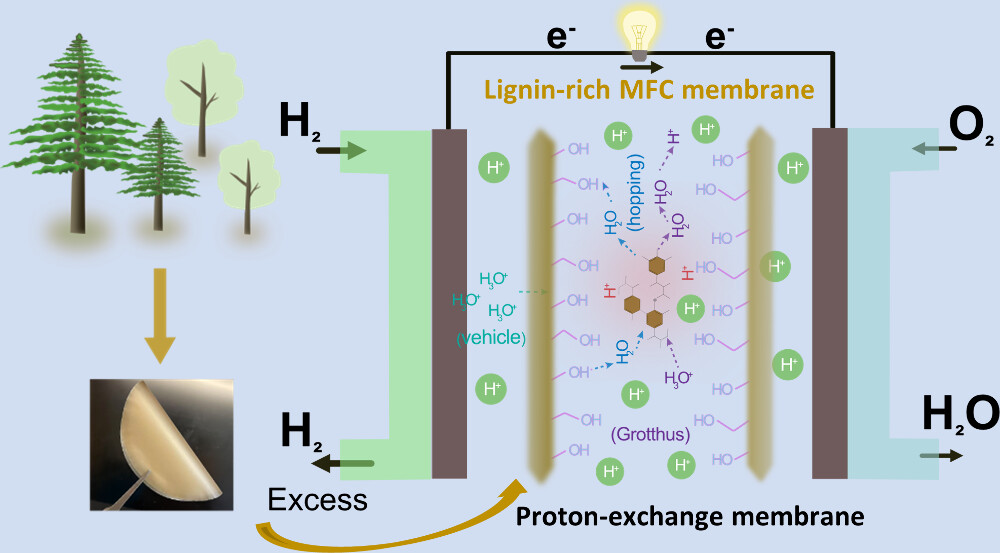
Lignin-Rich Microfibrillated Cellulose: A Sustainable Alternative for Proton Exchange Membranes for Energy Applications
ACS Sustainable Chemistry & Engineering Article ASAP- 研究論文
関連リンク
研究論文概要
Biobased alternatives to synthetic perfluorinated proton exchange membranes (PEMs) are needed to advance sustainable energy systems. This study evaluates lignin-containing microfibrillated cellulose (LMFC) as a material for PEMs. We produced LMFC from unbleached softwood and hardwood kraft pulps containing 11% and 14% klason lignin, respectively. Compared to lignin-free microfibrillated cellulose (MFC) membrane, LMFC membranes showed enhanced mechanical properties and proton conductivity due to its retained lignin content. The presence of carboxyl groups in LMFC led to doubled proton conductivity versus MFC under varied temperatures and high humidity conditions. While conventional PEMs show significant conductivity loss above 80 °C due to dehydration, both MFC and LMFC membranes demonstrated increasing proton conductivity at temperatures up to 120 °C under high humidity conditions. LMFC membranes exhibited tensile strength above 220 MPa with Young’s modulus exceeding 12 GPa. Gas transport tests revealed high selectivity for H2/N2 and H2/O2 pairs in LMFC and MFC membranes (α(H2/N2) ≈ 210), essential for preventing fuel loss in practical PEM applications. The achieved property ranges convincingly demonstrate LMFC’s potential as a sustainable alternative to conventional PEM materials.