Freestanding, Self-Healing CO₂ Separation Nanomembranes Based on PEG-Linked α-Lipoate Networks
ACS Appl. Polym. Mater. 2026, ASAP Article- Publications
Detailed description
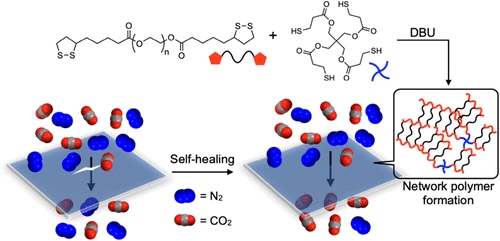
We have developed ultra-thin, self-healing polymer membranes for efficient carbon dioxide (CO₂) separation, offering a promising route toward more energy-efficient CO₂ capture technologies. The membranes are based on flexible polyethylene oxide (PEO/PEG) segments combined with dynamic disulfide bonds, which together provide high gas permeability and intrinsic self-healing ability.
By tuning the cross-linking density of the polymer network and reducing the membrane thickness to the nanoscale, we achieved very high CO₂ transport rates while maintaining strong selectivity over nitrogen. The presence of PEO chains enhances CO₂ affinity and molecular mobility, while reversible disulfide bonds enable the membranes to autonomously repair damage at mild temperatures.
Overall, this work demonstrates how combining CO₂-philic PEO segments with dynamic covalent disulfide chemistry can yield high-performance, durable, and self-healing membranes, paving the way for longer-lasting and more sustainable gas separation technologies.