Field measurements and stochastic modeling of particle removal in a spray scrubber with heat recovery at a 3 MW biomass boiler
Separation and Purification Technology, Volume 409, 15 October 2026, 139271- 研究論文
研究論文概要
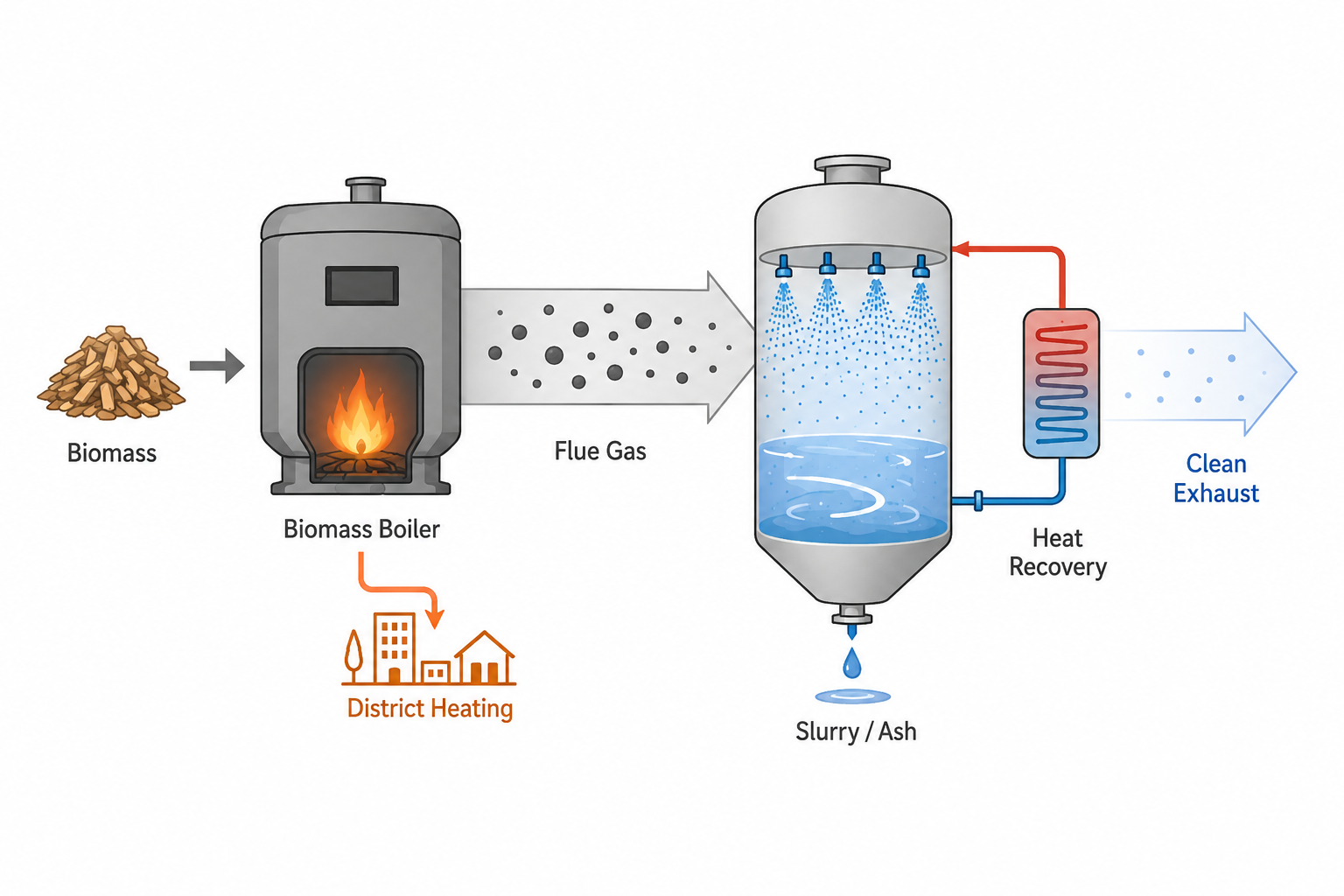
To mitigate climate change, we urgently need carbon-neutral energy sources. Combusting biomass for district heating is a well-established, energy-efficient option. However, biomass combustion generates particulate matter (PM), which has severe consequences for human health. To reduce PM emissions from medium-scale combustion facilities, economically feasible removal solutions are essential. This study investigates the performance of a centrifugal spray scrubber integrated with heat recovery installed at a 3 MW biomass-fired boiler, combining on-site aerosol measurements with stochastic modeling. Particle size distributions were measured using a combination of a low-pressure cascade impactor (LPI), an Aerodynamic Particle Sizer (APS), and a Scanning Mobility Particle Sizer (SMPS). In addition to particle morphology, we derived chemical composition and particle density through stoichiometric reconstruction of scanning electron microscopy (SEM) and energy-dispersive spectroscopy (EDS) measurements. Experimental results showed the scrubber achieved near-100 % particle removal for particles larger than 1 μm, while submicron removal ranged from 26% to 36% under varying process conditions. A module-based simulation model, developed and validated against these field measurements, reproduced the observed performance within the measurement uncertainties. The model analysis indicates that rear capture, thermophoresis, and diffusiophoresis work as critical mechanisms governing submicron particle removal in combustion-connected scrubbers. These results demonstrate the practical effectiveness of spray scrubbing for coarse PM control and clarify the mechanistic pathways that currently limit yet offer optimization potential for submicron particle removal when coupled with heat recovery.