Design of Highly Efficient Nanomembranes Toward Direct Air Capture. Essential Role of Nanolayer Interface
Advanced Materials Interfaces: Early View- 研究論文
関連リンク
研究論文概要
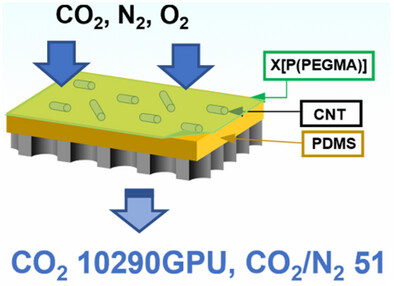
The role of membrane technology is growing in the mitigation of global warming via direct capture of CO2 from the atmosphere (DAC). Yet achieving both high permeability and selectivity remains challenging. In this study, the development of free-standing, nanometer-thick membranes is presented that are composed of layers of poly(dimethylsiloxane) (PDMS) and poly(ethylene glycol) (PEG). These nanomembranes are prepared by sequential spin coating of the precursor polymer solution and the subsequent radical cross-linking. The addition of carbon nanotube or cellulose nanofiber enhanced the physical stability of the nanomembrane. One of those nanomembranes exhibited record-breaking CO2 permeability (> 10,000 GPU) and CO2/N2 selectivity (>50) at ambient conditions. This gas permeation is a kinetic process and interface-controlled. This study offers a new design paradigm for highly efficient CO2 separation.